
Arabica & Pepper: How a Western Ghats Coffee Estate Actually Earns
This guide explains how a Western Ghats coffee estate earns, without quoting a per-acre income figure, because an honest one does not exist as a single number.
Search for what a coffee estate makes and you meet a wall of per-acre income claims that do not agree: forum guesses, project reports, one academic study, and sellers promising steady money. They use different varieties, regions, years and price assumptions, so they cannot be compared.
This guide does what most of those results do not. It shows the mechanics: where the money comes from on an estate that grows Arabica coffee and pepper, what it costs to run, and why the figure swings from one year to the next. You will see the revenue lines, one at a time, and what governs each.
The short version
A coffee estate earns from more than one crop, each sold on a market the owner does not control. Arabica coffee and black pepper are the main revenue lines, with slow-growing timber behind them; the yield depends on the weather and the price on a world-linked market, so no fixed per-acre number is honest.
In a little more detail: the coffee yield is set months before any sale, by the timing of the blossom and backing showers in March and April (agrinews.in, 09/30/2026). The price is set by the open market, not by the estate. Since India's coffee trade was freed in September 1996, growers sell through curing works and exporters, and the Coffee Board of India records and promotes the crop but does not fix the price (Wikipedia). Two crops, a yield the weather sets and a price the market sets: that is how the money actually arises, and it is why the figures online swing so widely.
How does a coffee estate actually make money
A managed coffee estate has several revenue lines, not one. The main money comes from the harvest sold each year, with slow-building timber standing behind it, and each line sells on its own market.
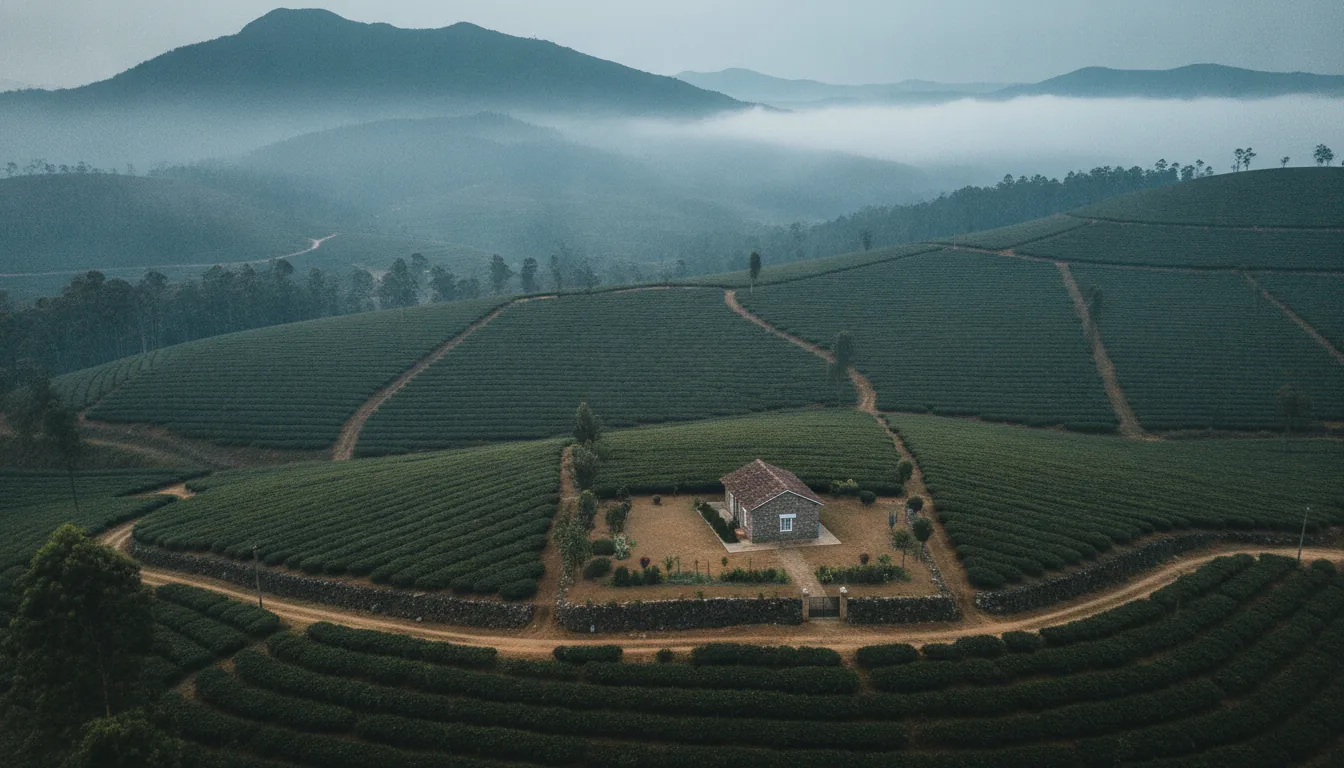
On a Western Ghats estate, the harvest lines are Arabica coffee and black pepper, grown together. Behind them stand longer-cycle trees: teak, and silver oak, which also shades the coffee. Some estates carry pomegranate as well. [FACT-GAP: which of these revenue lines applies on a given estate, to be confirmed by the named estate agronomist and the estate's own records, CDL N02.]
On a managed estate you do not sell the crop yourself. At Vibez, the harvest is marketed through Vibez Agro Tech Solutions, and each owner receives an annual yield statement that records what the estate produced. What none of these lines share is a fixed number: each carries a yield set by the weather and a price set by the market, so the revenue per acre is a range that moves, not a constant. To see why, it helps to walk through one coffee crop year.
What does a coffee year look like, from flowering to sale
A coffee year runs from the blossom showers to the sale, and the two are almost a year apart. Rain in March and April sets the size of the crop, picking runs from about November, and the coffee is sold months after that.
It starts with the weather. In the Western Ghats coffee regions, the pre-monsoon blossom showers arrive around March and April and trigger flowering; a second round, the backing showers, follows roughly two weeks later and sets the crop (agrinews.in, 09/30/2026). If those showers come late, or unseasonal rain falls in the weeks before flowering, the bloom is early and uneven and the crop is smaller, and a failed shower can force sprinkler irrigation to stand in. So the size of the harvest on a coffee plantation is largely decided in a few weeks of spring, long before anyone is paid.
Then comes the long wait. Arabica is picked from about November to January, and Robusta runs on into February and early March (coffeehunter.com, Mercanta, 09/30/2026). The picked coffee is processed, as washed parchment or dried cherry, then sent through curing works for hulling and grading, and on to exporters and roasters, with most export shipments leaving in March and April. The Coffee Board of India records these crop estimates, but the calendar is set by the monsoon, not by any office. One more crop shares this same ground and the same shade trees: pepper.
Where does pepper fit, and why does a second crop matter
Black pepper grows as an intercrop on the same estate, trained up the shade trees rather than planted on its own ground. That gives a Western Ghats coffee plantation a second harvest, on a separate market, from land that is already working.
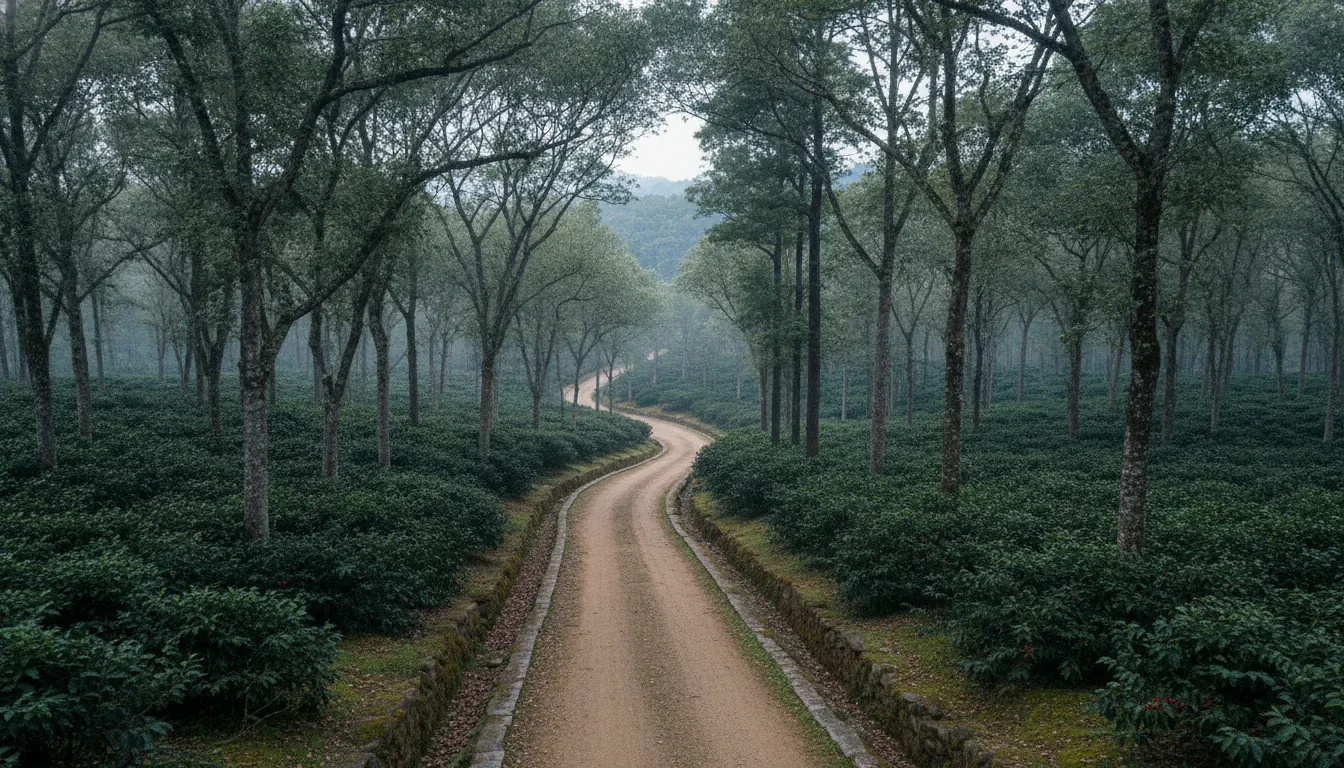
In practice the pepper vines climb the shade trees, silver oak among them, that also shelter the Arabica below (Wikipedia; fact sheet). A second crop does not promise a bigger income. It changes the risk: the estate is no longer riding on one harvest and one price. If coffee has a weak year, pepper may not, and the reverse. A second line spreads the exposure across two markets; it does not remove the weather risk or the price risk, and pepper's own price is as changeable and as far outside the owner's hands as coffee's. Both crops, then, meet the same two questions every year: what did they yield, and what did they cost to grow. The cost side is where income and profit part ways.
What does it cost to run a coffee estate
Running an estate has standing costs every year, harvest or no harvest. Labour, inputs, maintenance and processing all come before a single rupee of income is counted, which is why income and profit are not the same word.
Start with labour, because coffee is hand-picked when the berries ripen, and ripe berries do not wait (Wikipedia). Then inputs: the planting material, the soil and shade management, and the water and power behind irrigation when the showers fail. On a managed estate there is also maintenance, which on the Vibez model covers the plantations and shared grounds, internal roads, drainage, shared facilities and routine supervision. The maintenance fee is set per owner and is not published here; the point is the cost lines it stands for, not the figure. Finally there is processing: the crop is prepared and sent through curing works before it can be sold, and the harvest is marketed through Vibez Agro Tech Solutions.
This is exactly what the popular per-acre income figures tend to leave out. One widely shared project report even notes that its own numbers exclude land rent, transport and depreciation (agrifarming.in, 09 Dec 2023). Strip those out and an income figure can look far healthier than the money an owner really keeps. Costs are also the reason two estates with the same crop can end a year far apart, which is the difference between a good year and a bad one.
What separates a good year from a bad one
A good coffee year needs the rain to arrive on time and the price to hold. A bad year is usually a failed or mistimed shower, a price dip, or both at once, and none of those is inside the owner's control.
The weather half you have already met. When the blossom showers and backing showers come on time, the crop sets evenly and picking is steady; when they come late, or unseasonal rain arrives during the dry stress period before flowering, the bloom is patchy and the yield drops, and growers fall back on sprinkler irrigation to save what they can (agrinews.in, 09/30/2026). Arabica, with its longer stress period, is the more exposed of the two; Robusta is a little hardier.
The scale of the swing is not a small thing, and you do not have to take an estate's word for it. The Coffee Board of India's own post-blossom estimate for the 2025-26 crop was about 403,000 MT, and its final estimate for the same year settled near 373,000 MT, roughly 7 per cent lower, inside a single crop year (data pack, 09/30/2026). If the national body's own number can move that much in months, a fixed per-acre figure for one estate deserves real caution. That caution starts with a simple question: who sets the price?
Who sets the price of coffee, and why is it not the owner
The price of coffee is set on a world-linked export market, not by the estate that grows it. Since India freed its coffee trade in 1996, growers sell their crop freely through curing works and exporters, and the price they get moves with the species, the processing grade and the world market.
Two of those are decided before the crop even leaves the estate. Arabica sells for more than Robusta, and within each, washed parchment coffee sells for more than dried cherry, so the same bush can fetch different prices per kg depending only on how it is prepared (data pack, 09/30/2026). Farm-gate prices sit in four grades along exactly those lines, Arabica parchment at the top and Robusta cherry at the base. This guide does not print today's figure, because there is no single one to print.
That is also why a daily coffee rate, the kind searched for as today's rate in Sakleshpur, is a live quote that changes with the market, not a stable number an estate can promise. Before 1996 the Coffee Board of India pooled growers' coffee and ran exports; after full liberalization the Board moved to research, promotion and statistics, and it no longer sets the price (Wikipedia). The grower is a price-taker. Understanding that is what makes the next point land: why any single per-acre earnings figure, including one from a seller, should be read with suspicion.
Why should you distrust any per-acre earnings figure, including ours
A per-acre earnings figure only means something when its variety, region, altitude, year and price assumption travel with it. Strip those away, which is what most of the popular sources do, and the numbers stop being comparable, even though they are stacked side by side as if they were.
Look at what is published. One peer-reviewed study reported a gross of roughly Rs 45,868 per acre for Arabica, for one region in one year (journalajaees.com, 03 Sep 2021); a Robusta estate at a different altitude would not match it. A widely shared project report put total income from the farm near Rs 3,60,000, but on a per-hectare basis, which is about two and a half acres, and it warned that its own figures were not permanent and left out land rent, transport and depreciation (agrifarming.in, 09 Dec 2023). Social threads quote figures from other countries running into the millions. These sit in different units, different years, different regions and varieties, and different price assumptions, so they cannot be lined up and compared, and averaging them is worse than reading none. Even the Coffee Board of India, the most authoritative source on the crop, publishes production and prices, not a per-acre profit for any one plantation, because that profit turns on the estate's own costs, which no national table can know.
So we will not hand you a per-acre profit number of our own, and you should be wary of anyone who does. A single figure with a Vibez logo on it would mislead in the same way, because a coffee estate like ours faces the same weather and the same market as every other. It would also cut against how we describe what we do, which is long-term stewardship of the land, not a promised return (fact sheet). What we can offer in its place is not a number at all. It is a set of things you can check for yourself.
What can we show you instead of a number
Instead of a projection, we offer things you can check for yourself: a working estate you can visit, the annual yield statement every owner receives, and the named people who run the crop.
The estate is Vibez Coffee Estate in Sakleshpur, a completed and working coffee estate you can walk before you decide anything. Each owner receives periodic plantation updates through the year and an annual yield statement from Vibez Agro Tech Solutions that records what their land produced, so the yield you are shown is your estate's own record, not a brochure average. For the public benchmark, the Coffee Board of India's production and price data is open to anyone, which lets you check any claim against a neutral source.
A visit, a document and a named person are slower than a headline number. They are also the only honest answer to what it will earn, which is this: come and see what it grows, and decide for yourself.