
A coffee estate is a working plantation, not a bare field, and that changes what you have to check before you buy one. The land title still matters, and you still run every ordinary check on it. On top of that title search, though, a coffee estate carries a second layer: living trees of a particular age and variety, a shade canopy that keeps them alive, water that has to hold through the dry months, resident labour with legal rights, and plantation records that either back up the seller's story or quietly contradict it.
Most people searching for a coffee estate in Sakleshpur or Chikmagalur are shown tours, homestays and price listings. Almost nobody is shown the checklist. This guide is that second layer, taken one check at a time, for the Western Ghats coffee belt around Sakleshpur in Hassan district and Chikmagalur district.
What does coffee-specific diligence add to an ordinary land check
Coffee-specific diligence is a layer of checks that sits on top of the ordinary land-title search. It verifies the coffee trees, the shade canopy, the water in both the dry season and the monsoon, the estate labour and its housing, the plantation records and the Coffee Board of India registration, and the slope, elevation and access, all before you judge the price. Title and trees come first; price comes last.
The ordinary title search still applies in full. You still confirm the RTC or Pahani (the Karnataka revenue record for the parcel), the Encumbrance Certificate that shows any loan or claim, the mother deed and mutation chain (the original title and the record of every transfer since), and the DC conversion status (whether farmland has been legally converted for non-agricultural use). On a coffee estate you also take on duties under the Plantations Labour Act, 1951 when resident workers come with the land. The rest of this guide is the coffee layer, check by check.
How do you read the coffee trees, their age, variety and productive stage
The coffee trees are the productive asset you are actually buying, and their variety, age, spacing and health decide the parcel's worth far more than its acreage does. Start with the variety, block by block. A parcel sold simply as coffee can be Arabica, Robusta or a mix, and the two are not interchangeable: Arabica needs higher, cooler ground and more shade, carries a higher price, and is more prone to pests, while Robusta is hardier and grows lower down. If the seller says Arabica, confirm it in each block, not only at the gate. Many blocks also carry black pepper trained up the shade trees, so factor that second crop in as you walk.
Then read the age and productive stage. A young infill planting and an old, tired stand can look similar to an untrained eye, yet one is years from full yield and the other is past it. Ask which blocks were planted when, and look for the pruning cycle and the nutrition signs that show the estate has been worked rather than left. On Arabica in particular, inspect for white stem borer and leaf rust, the two problems that hollow out a coffee block from the inside. Spacing and plant density are worth checking against the recognised norms for the variety and elevation, though the exact figures should come from a dated Coffee Board of India or ICAR-CCRI source rather than from the seller.
Why is the shade canopy the asset nobody values, and how do you judge it
The shade canopy is the layer of taller trees that Arabica coffee grows under in the Western Ghats, and its species mix, density and health decide whether the coffee below it survives the sun and the monsoon. A thin or dying canopy is a real cost that the asking price rarely reflects, because it can take years to rebuild.
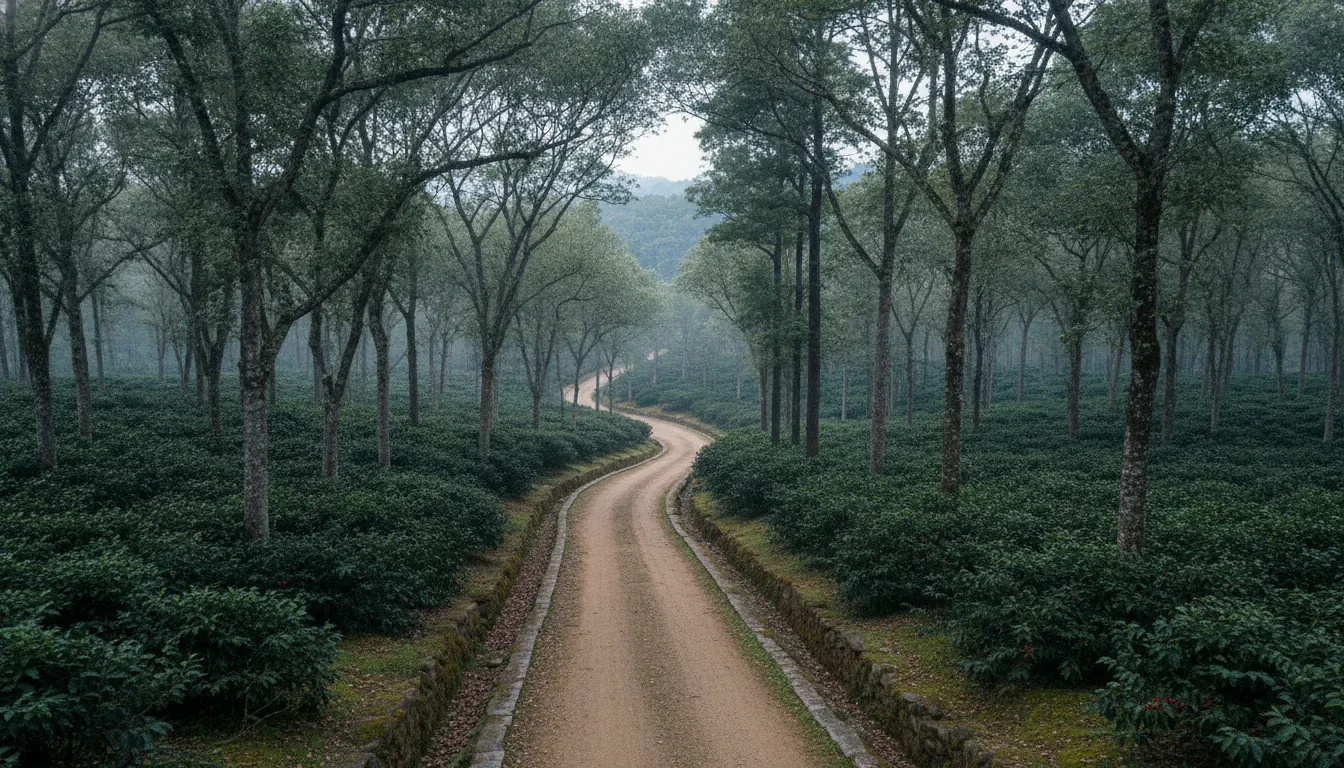
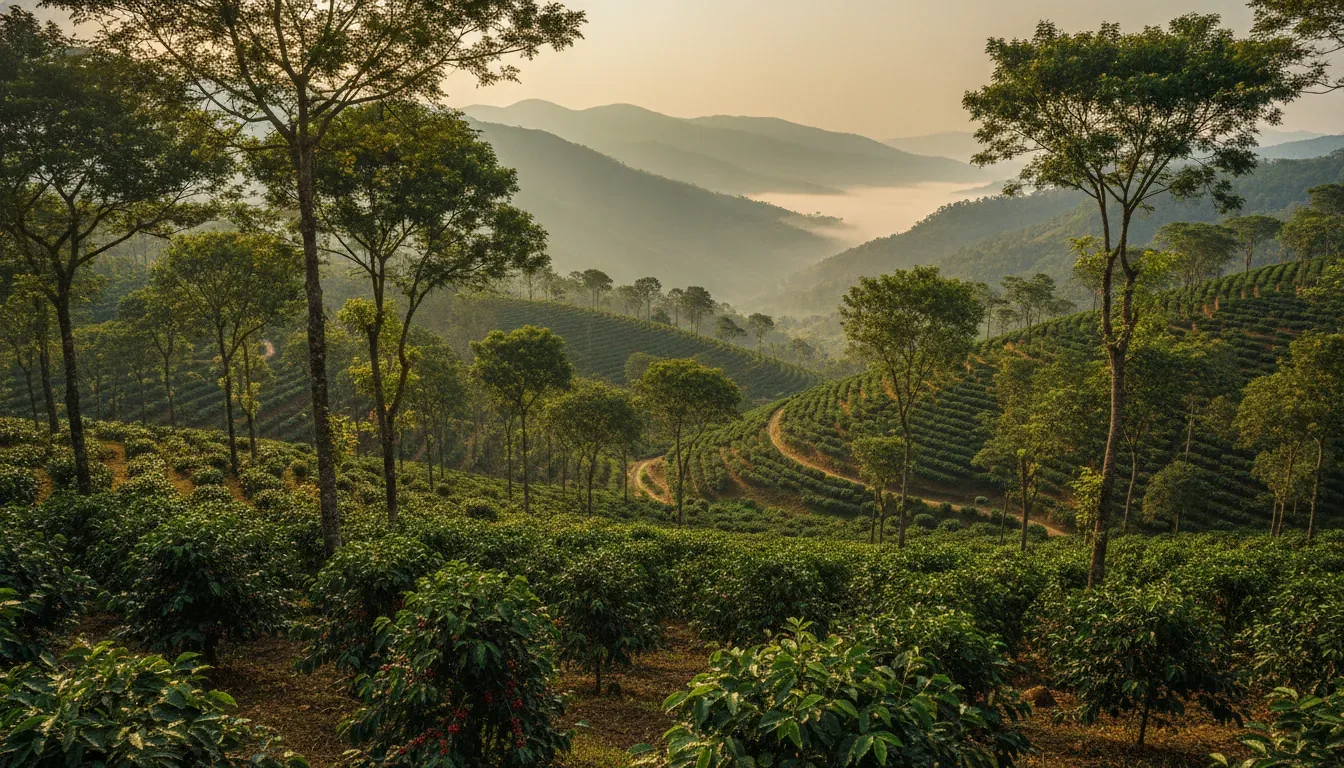
Western Ghats Arabica is grown under a two-tier mixed shade, according to the Chikmagalur Arabica record filed for Geographical Indication protection (application filed 2017). The lower tier uses trees such as Erythrina, and the upper tier uses Albizia, Ficus and Terminalia. Managed estates often add silver oak, which doubles as timber. Judge the canopy on three things: whether the species mix suits the block, whether the density gives even shade without smothering the coffee, and whether the trees are healthy rather than storm-damaged or felled. There is a second reason to look up. Black pepper is grown as an intercrop trained on the shade trees, so the canopy is carrying a second crop of its own. For any figure on shade or density, the sources to trust are the Coffee Board of India and dated ICAR-CCRI material, not a brochure.
How do you check the water on a coffee estate, in the dry season and the monsoon
Water on a coffee estate has two sides, the supply in the dry months and the drainage in the monsoon, and you check both. Visit in the dry season, ideally March or April, when supply is at its lowest. A stream, spring or pond that looks full in the monsoon can fail by summer, so confirm that the source is perennial year round and test the borewell for depth and flow rate rather than taking the seller's word. Ask neighbours what the source does in a dry year; they will tell you what a one-day visit cannot.
Then turn the check around for the monsoon. The same rain that feeds the coffee can rot its roots where the land does not drain, so look at the slope runoff, the drainage and any sign of standing water. One point the listings skip: the right to use the water is a legal question, not something that automatically comes with the land. A borewell, a stream diversion or a shared tank can each carry conditions. Put the water right in front of your advocate.
What do slope, aspect and elevation do to a coffee parcel and its access
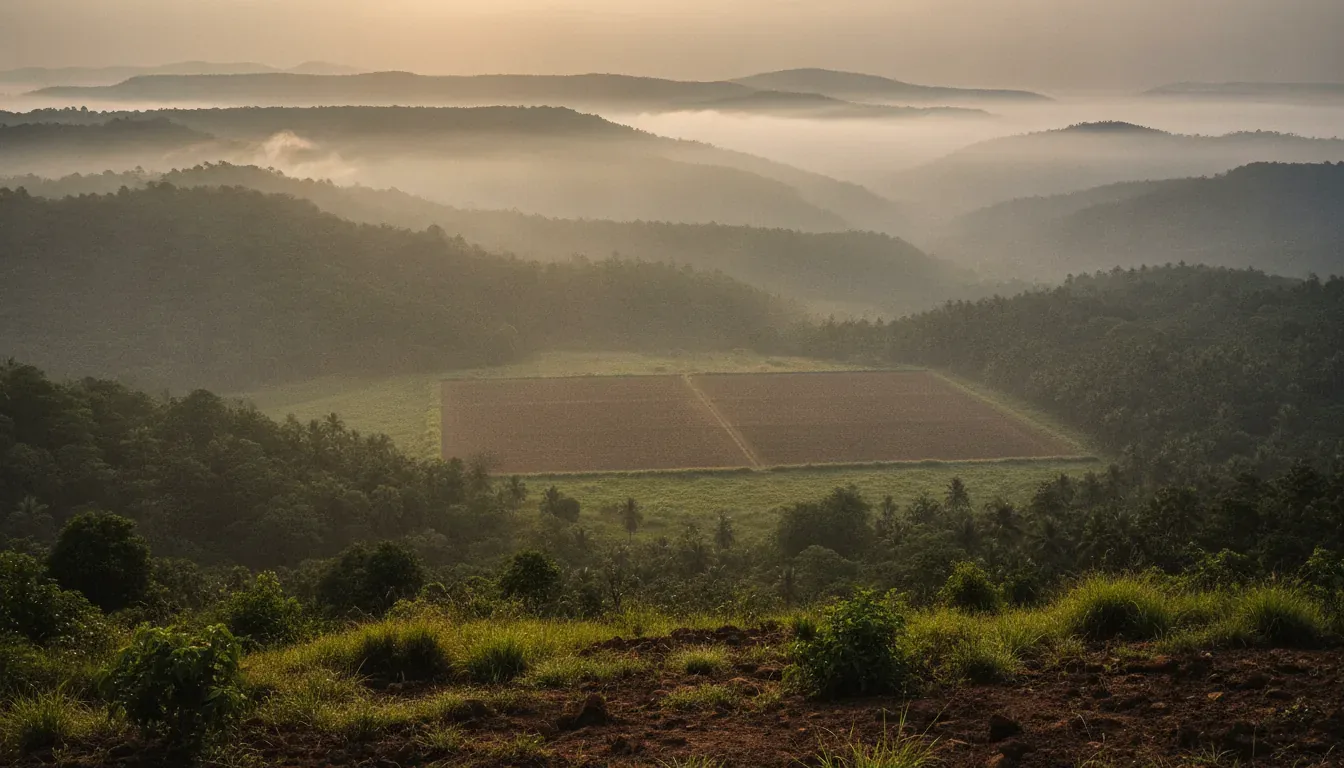
Elevation is the height the parcel sits at above sea level, and it decides which coffee variety belongs there and with it the yield you can expect, while the slope and the way the land faces decide its drainage, its erosion risk and how reachable it stays when the rain comes. In the Chikmagalur belt, Arabica is generally grown between roughly 700 and 1,200 metres above sea level, per the Chikmagalur Arabica GI record. Sakleshpur sits in the same Western Ghats belt, but do not assume a district figure applies to a single parcel; confirm the actual elevation of the land in front of you.
Slope and aspect do quieter work. A gentle, well-drained slope sheds the monsoon and holds its soil; a steep one can grow good coffee and still be hard to work, prone to erosion, and awkward to reach. There is also a land-use question specific to the Western Ghats. Parts of the range are proposed as an Ecologically Sensitive Area, and as of the seventh draft notification dated 29 July 2026 that proposal is still a draft and not in force. If it is finalised, it could regulate tree-felling, new construction and groundwater use in the villages it names. Whether a parcel falls inside the current draft is a question for your advocate, checked against the version in force on the day you buy.
What do you need to know about the estate's labour before you buy
The estate's labour is the group of resident and seasonal workers who plant, tend and pick the coffee, and an operating estate transfers with them. That makes labour a real check to run. Coffee picking is seasonal, and parts of the belt are short of harvest labour, so ask how the estate has staffed its harvest in recent years and who the workers are.
There is a legal side as well. The Plantations Labour Act, 1951 places duties on the employer of a coffee plantation above a certain size, reported as around 5 hectares and 15 or more workers, to provide and maintain worker housing, known on estates as labour lines, along with water, medical care and welfare facilities. If resident workers come with the land, you take on those duties. Confirm the exact threshold and the current Karnataka position with your advocate before you sign. One advantage of buying into an operated estate rather than a bare plantation is that a company running the estate handles this labour coordination for the owner.
Which plantation records and Coffee Board registration must you verify
A coffee estate's plantation records are the paperwork that proves it is a registered, working plantation rather than just land with trees on it, and each record verifies a different claim the seller is making. The first is the Coffee Board of India registration. Coffee estates are registered with the Board under the Coffee Act, 1942, so confirm the estate holds a current registration and that it can be transferred into your name. Registration is also what lets an owner reach the Board's replanting and development support.
The second record is the production history. Ask for three to five years of yield and input records, the bags or kilograms produced and what was spent on manure, pruning and spraying to get there. These test the seller's productivity story, and a seller who cannot produce them is telling you something. The third is the processing assets, the pulper and the drying yard, whose condition and ownership should be on paper. On an operated estate this trail is kept as a matter of course: a company such as Vibez Agro Tech Solutions markets the harvest and issues owners an annual yield statement, which is the kind of documented history you want to see in any estate you buy.
How do you judge the access road and monsoon isolation
The access road is the route from the public road to the parcel, and its surface, its width and above all its legal right of way decide whether you own a reachable estate or a landlocked one. A dry-season visit flatters the road. Drive the last mile imagining it in heavy rain: is it tar or mud, is it wide enough for a loaded vehicle to turn, and what becomes of it in July. While you are there, walk the boundary too, and confirm the corner stones match the survey sketch.
The legal side matters as much as the surface. A parcel that can only be reached across someone else's land is not securely accessible, however good the drive looks, so the right of way needs to be confirmed in the title rather than assumed from use. In the Western Ghats, monsoon isolation is real: landslides and washed-out roads cut parcels off every season, so ask what access is like at the height of the rain, not only on the day you visit.
Do the ordinary land-title checks still apply, and can you even buy it
The ordinary land-title checks are the standard Karnataka diligence you would run on any parcel, and they apply to a coffee estate in full, before a single plantation check counts. That means the RTC or Pahani, the Record of Rights, Tenancy and Crops, whose owner name must match the person taking your money; a clear Encumbrance Certificate covering many years, which shows any loan or claim on the land; the mother deed and the mutation chain, the original title and the record of every transfer since; the DC conversion order where the land use has changed; the PTCL position, which confirms the land is free of the Prohibition of Transfer of Certain Lands restrictions that can undo a sale; and a certified 11E sketch where the parcel has been split from a larger survey number. The full walkthrough of these documents deserves its own guide, and you should read it alongside this one.
There is a prior question too: can you buy it at all. Since the Karnataka Land Reforms (Amendment) Act of 2020 struck down the old Section 79A, resident non-agriculturists, including a salaried professional, can generally buy agricultural and plantation land in the state, within the holding limits, though irrigated first-class land stays restricted. Non-resident Indians and foreign nationals generally cannot buy agricultural or plantation land under FEMA, the foreign-exchange law, and this guide assumes a resident buyer. Eligibility turns on your own status, so confirm it with your advocate.
What should you hand your advocate, and what should you commission
The rule is simple: inspect what you can yourself, and commission the rest. The advocate's list is the set of legal items only a Karnataka land lawyer should clear, and it is worth handing over as one indexed pack rather than in pieces. It holds the title chain and the Encumbrance Certificate, the DC conversion and PTCL position, your eligibility to buy, the water and right-of-way rights, the Coffee Board registration and plantation records, the Plantations Labour Act obligations that come with resident workers, and the current Western Ghats ESA status for the parcel's village.
The agronomist's list is separate. A qualified agronomist or estate manager should assess the trees' variety, age and health, the canopy condition, and the realistic productive stage of each block, with any figures cited to the Coffee Board of India or ICAR-CCRI. What you keep for yourself is the ground truth no document shows: the dry-season water test, the boundary and access walk, and the parcel in the rain. A good operator makes this easier by handing your advocate a pre-assembled document pack on request, which is a fair sign of how an estate is run.