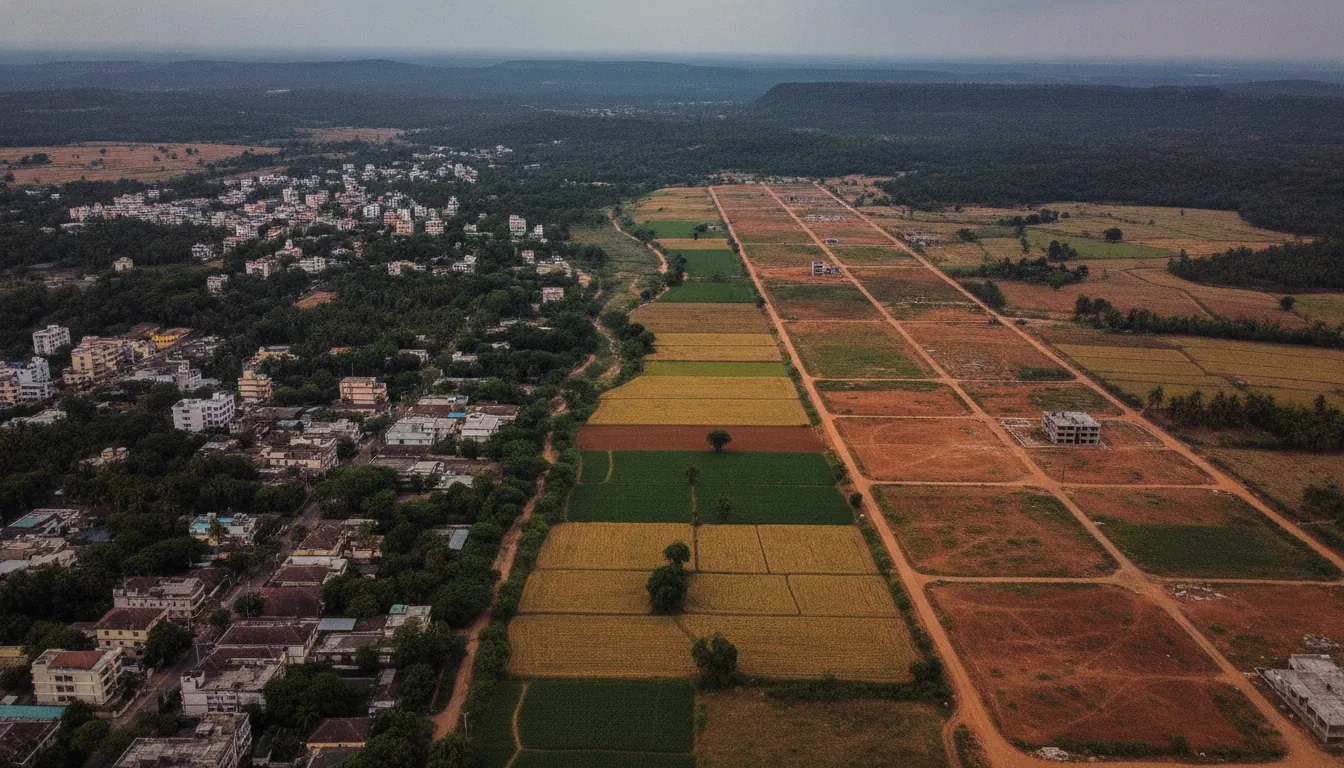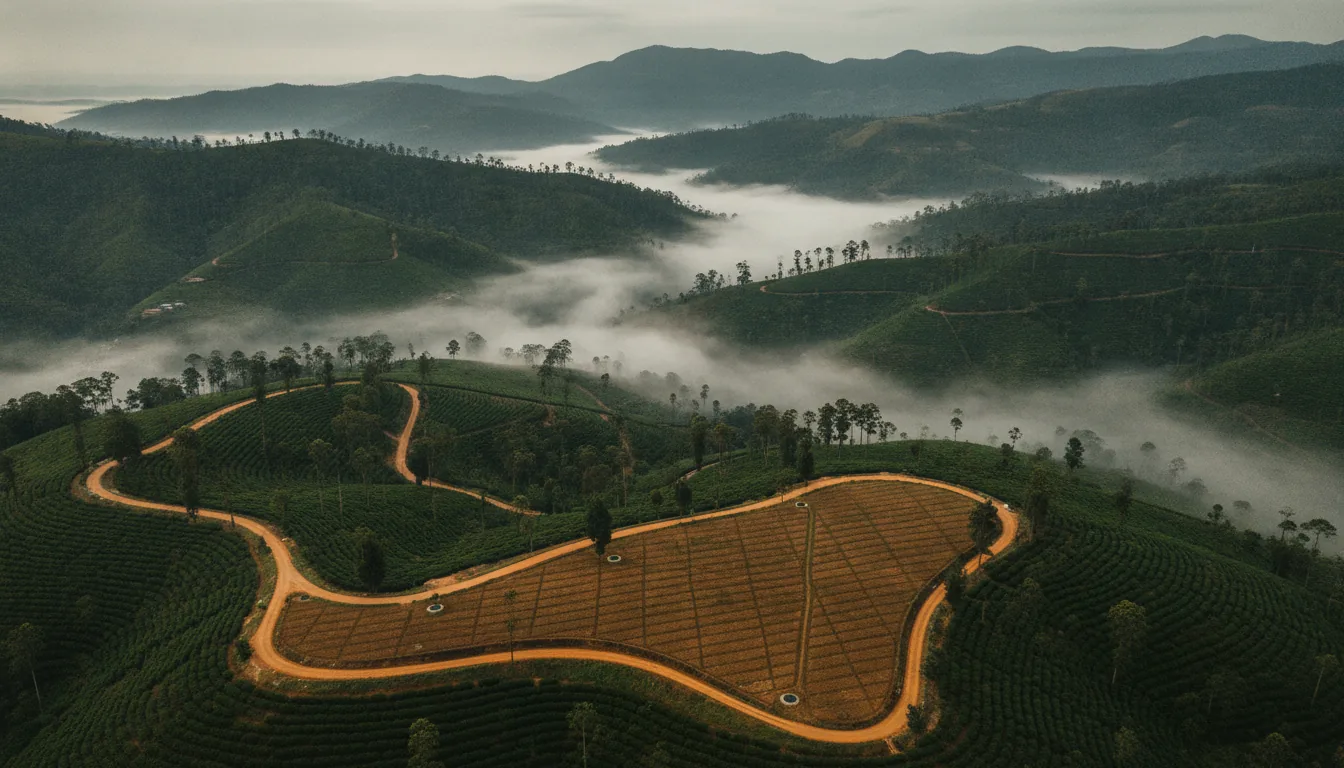

November on a Western Ghats coffee estate is when picking begins: the first ripe Arabica coffee is picked and pulped the same day, lime goes onto the soil, and the traps for the white stem borer stay up until the end of December. Black pepper picking follows from December.
That is the work the crop needs on the estate this month, on a Western Ghats estate such as Vibez Estates' coffee land in Sakleshpur. If you are weighing up a managed plot, it is also a fair place to start asking what you are paying for.
This page sets out the managed farmland work month by month, who does it, what an owner receives, what it costs and what happens if the work is not done, including the parts that are not yet in writing. The short version comes first.
What does Vibez actually do on a managed plot
Vibez Estates handles the planting, upkeep, harvest and sale of the crop on a managed plot it has sold, and maintains the common estate, under a maintenance agreement that is separate from your title. The title is registered in your name. The harvest of Arabica coffee, black pepper and the other crops is marketed through Vibez Agro Tech Solutions. Owners receive plantation updates and an annual yield statement. The charge is set per square foot per year, with its scope and exclusions written down.
That is what Vibez does on a managed plot. The detail changes with the month and with the crop, so the calendar comes first.
What happens on a coffee and pepper estate, month by month
A Western Ghats coffee estate runs its year around the crop: picking from November into the new year, blossom showers in March and April, the monsoon from June, and borer and disease work on both sides of it.
Arabica on a Western Ghats estate is picked from November to January, and Robusta follows into February and early March. That is the coffee harvesting season in Karnataka.
Rain sets the crop months before anyone picks it. Blossom showers in March and April bring the coffee into flower, so the calendar below moves a little with the weather each year.
|
Month |
What the coffee and pepper need |
|
January |
Arabica picking finishes, and Robusta picking carries on into February and early March. The black pepper harvest is under way: spikes are picked when one or two berries turn yellow to orange, then sun-dried for 7 to 10 days. |
|
February |
The coffee bushes are lightly pruned after picking, and bushes badly hit by die-back are cut back and given a pre-blossom spray. Shade regulation on the silver oak and other shade trees is done after the harvest. Pepper picking and drying continue. |
|
March |
Blossom showers (March to April) bring the coffee into flower, and backing showers about two weeks later set the crop. If the showers come late or fail, the estate irrigates by sprinkler. Tracing of white stem borer is finished by the end of the month, and the shade is left alone through March and April. |
|
April |
Borer pheromone traps go up for April and May. The pepper standards, the trees the vines climb, are pruned. Lime or dolomite goes on the pepper in alternate years, and the vines are watered until the monsoon. |
|
May |
The pre-monsoon round of fertiliser goes on the coffee and green manure crops are sown. Spraying with Bordeaux mixture protects against leaf rust and, before the monsoon breaks, black rot. Pepper gets its first fertiliser split and, after the first showers, a spray and drench against foot rot. |
|
June |
The south-west monsoon arrives. Coffee bushes are handled, centred and desuckered (June to July). New pepper vines are planted and manure goes on at the start of the rains. |
|
July |
Desuckering and pepper planting continue. Heavy rain limits how much field work can be done. |
|
August |
The second fertiliser split goes on the pepper (August to September), with a second pruning of the standards if the shade is heavy. |
|
September |
The post-monsoon leaf rust spray goes on. Borer tracing is finished by the end of the month, and traps for the shot hole borer go up and stay until February. Desuckering is repeated if needed. |
|
October |
Young coffee plantings are dug over and scuffled (October to November), and borer traps stay up to December. Pepper is sprayed again before the north-east monsoon, with a further drench if the rains run long. Weeding and mulching begin and run to December. |
|
November |
Arabica picking begins, and the fruit is pulped on the day it is picked. The Coffee Board names November as the best month for lime. |
|
December |
Arabica picking peaks. The pepper harvest begins in the hills. Borer traps stay up to the end of the month. |
Sources: the Coffee Board of India's advice for planters; the Directorate of Arecanut and Spices Development's Good Agricultural Practices for Black Pepper (2015); harvest windows from coffee trade sources.
Which Vibez estates follow this calendar. The Sakleshpur estates sit in the Western Ghats. The plateau estates near Bengaluru grow different crops on a different clock.
What happens on the plateau estates, and on the timber and shade trees
Pomegranate does not follow the month grid. The grower picks one of three flowering seasons a year, and the work runs in days from that start, not by calendar month.
The three seasons, called bahar, are Ambe (January to August), Mrig (May or June to December or January) and Hasta (September or October to April or May). The ICAR-National Research Centre on Pomegranate advises taking only one season per year. Each season starts with a rest period of two to three months and a stress period of one to two months. Then come flowering and fruit set, and the harvest lands roughly 181 to 230 days after leaf fall. The orchard is watched more closely after the first unseasonal rains in May and June.
Teak is timber on a long cycle. There is little month-to-month work once the trees are established, and thinning is measured in years: published plantation practice puts the first thinning at five to seven years. The schedule for Vibez's own teak is part of the confirmation above.
Silver oak is the shade over the coffee, and pepper vines are trained up the shade trees.
Chikkaballapur sits on the Nandi Hills plateau, not in the Western Ghats. Which estate grows which crop is still to be confirmed.
Under every crop, some work goes on every month.
What does the estate team do every month, whatever the crop
Vibez's maintenance agreement lists seven lines of common-estate work, from plantations and roads to supervision and owner updates, carried out every month whether or not you visit.
-
Plantations and common landscaping: The crop and the shared grounds are kept up, so the plot you return to looks like the plot you bought.
-
Internal roads and common access areas: You can reach your plot after the monsoon, which is when estate roads take the most damage.
-
Sewage and drainage systems: Drains are what stand between heavy rain and washed-out soil, so their upkeep matters most from June to September.
-
Common infrastructure: Shared structures on the estate are maintained under the same agreement, not left to individual owners.
-
Routine estate supervision: Someone on the estate sees a problem before an absent owner could.
-
Labour and material coordination for common maintenance: Vibez arranges the workers and the supplies; you do not hire anyone.
-
Periodic owner updates and issue escalation: Upkeep is reported to you, and problems have a written route to be raised.
The agreement does not yet state how often each job is done or how fast an issue is answered. The client has committed to a written service charter that will set those out, and until it exists this page does not state any frequency. Each of these lines needs a person to do it.
Who does each job
The work on a Vibez estate is accountable in three places: operations sit with the Director responsible for operations and rural community compliance, the field work with the on-site estate team, and the sale of the harvest with Vibez Agro Tech Solutions.
-
Vijayalakshmi Urs S, Director, is responsible for operations and rural community compliance.
-
Ashwin Kumar is Founder and Director.
-
The on-site team works on each estate, and it is the team that shows buyers around on a site visit.
-
Labour and materials for common maintenance are coordinated by Vibez under the maintenance agreement.
-
Vibez Agro Tech Solutions markets the harvest.
As a benchmark, a farm manager's responsibilities are usually these: planning the crop year, organising labour and inputs, watching the crop, soil and water, keeping records and reporting to the owner. You should be able to find out who does each of those on your estate.
Some roles are not yet published. Vibez has not yet named an estate manager or an agronomist, or said how many people work each estate. A designated relationship manager for each owner is part of what the company intends to build. It is not in place yet, so this page does not promise one.
All of that work should reach the owner in some form.
What do you see and receive as an owner
A Vibez owner receives plantation updates through the year and an annual yield statement, on the schedule the maintenance agreement sets.
- Reporting: How often updates arrive is set in the agreement. What an update and a yield statement contain will be shown here as a real example.
- Access: You can visit the estate with the on-site team.
- Produce: The harvest is picked, processed and sold through Vibez's marketplace, run by Vibez Agro Tech Solutions. Whether you can take some of your own harvest home.
The commonest complaint across managed farmland is simple: owners stop hearing from the operator once they have paid, and maintenance charges arrive without explanation. The defence is a reporting schedule written into the agreement and then kept, so you get updates without having to chase them. A modest schedule that is kept is worth more than a generous one that is missed. Ask how often in writing before you sign, and ask to see a past update.
Updates are only half of what an owner wants to know. The other half is the cost.
What does the operation cost you, and what is not included
Vibez's maintenance charge is set per square foot of your plot each year, on the scope and exclusions written into the customer agreement. The rate itself is not published here.
It covers the seven lines of estate work above. It excludes:
-
cottage repairs specific to your cottage
-
interiors
-
utilities
-
hospitality operations expenses
-
owner-requested services
Each exclusion is handled separately, and the agreement says how. Any revision to the charge has to follow actual operating costs and be communicated to owners in advance. The agreement also sets the scope, the start date and how often you are billed.
The exclusions are printed because finding one late is what turns into a complaint. Read them before you sign. Commercial terms are project-specific and set out in the agreement.
What it costs is one question. What happens if the work is not done is the one most operations pages leave out.
What happens if the work is not done
If the estate work slips, what protects the owner today is this: the title stays in your name, problems go up the written escalation route, and the rest depends on what your agreement says, which is why you read it before you sign.
In writing today. The title is registered in your name, so your land stays yours whatever happens to the operator. Issue escalation is part of the written maintenance scope. The agreement states the scope, the billing and how the charge can change, and any increase must follow actual costs and be notified in advance.
Not yet in writing. Response times and inspection frequency are not fixed yet; they belong to the service charter the client has committed to build. Two more items are open:
-
The remedy if scheduled work is missed, such as a fee adjustment or a right to end the agreement.
-
The term of the maintenance agreement, and what happens if Vibez stops operating.
What to ask for before you sign. Careful contracts in this category cover the following, and you are entitled to ask for each:
- The scope of the work, line by line.
-
Performance standards: what counts as the work being done.
-
Inspection or audit rights for the owner.
-
How a complaint is escalated, and how fast it must be answered.
-
Whether you can end the maintenance agreement without affecting your title.
The same questions apply to any operator you are comparing. Every claim on this page can also be checked on a visit.
How can you check any of this on a visit
A site visit can show whether the work on this page is happening, if you visit a finished estate, ask what is being done this month, and see an owner update with your own eyes.
- Visit a completed estate, not only the one on sale: Vibez Sirivana in Chikkaballapur, Vibez Coffee Estate in Sakleshpur, or Mythri Farms.
-
Ask the on-site team what work is under way this month, and check it against the calendar above.
-
Walk the roads and the drains. Both are in the written scope, and the monsoon tests them.
-
Ask to see the last plantation update an owner received.
-
Ask who supervises the estate day to day.
-
Ask for the maintenance agreement and read the exclusions and the remedy with your advocate. Vibez shares the brochure, the title flow and the maintenance agreement up front.
-
Ask to meet an owner the sales team did not choose.
Timing helps. November to January shows coffee picking in the Ghats. February to May is the window for checking water before the monsoon.
Vibez Estates has been operating since 2009, with 25+ projects completed and 1,000+ customers, as at September 2026. The questions below are the ones buyers ask most about operations.