
The first question most couples ask is which of the two costs less. The question that decides whether the place gets used is a different one: who keeps it running between visits.
If you are the partner who has been brought along to give a verdict, you may have a quieter worry. You may be picturing a family that goes twice and never again, and a house that sits empty for weeks with nobody there when something breaks. Those are worries about upkeep, not price, and they are fair ones to raise before anyone signs.
This guide compares a built farmhouse and a managed farm plot as a second home within reach of Bengaluru, on the work each one needs and who does it. It says plainly where each one wins, so you can pick a place your family will use. The short answer turns on one thing about your own family.
Which one suits your family - a farmhouse or a managed farm plot
A built farmhouse suits a family that wants full control and has someone, itself or a person it trusts nearby, to keep the place running between visits. A managed farm plot suits a family that wants land, with the title in its own name, and a cottage to stay in, without running the farming, upkeep and supervision itself; in return it accepts an operator's rules and an annual maintenance charge. The deciding question is who does the upkeep, and whether you will check that it is done.
A built farmhouse suits your family if:
- you can visit often, or have someone you trust living close to the land
- you want to decide the design, what is grown and who comes
- you are ready to hire, pay and supervise the people who keep it running
A managed farm plot suits your family if:
- you want land in your own name but cannot be there often
- you would rather an operator did the farming and the common upkeep
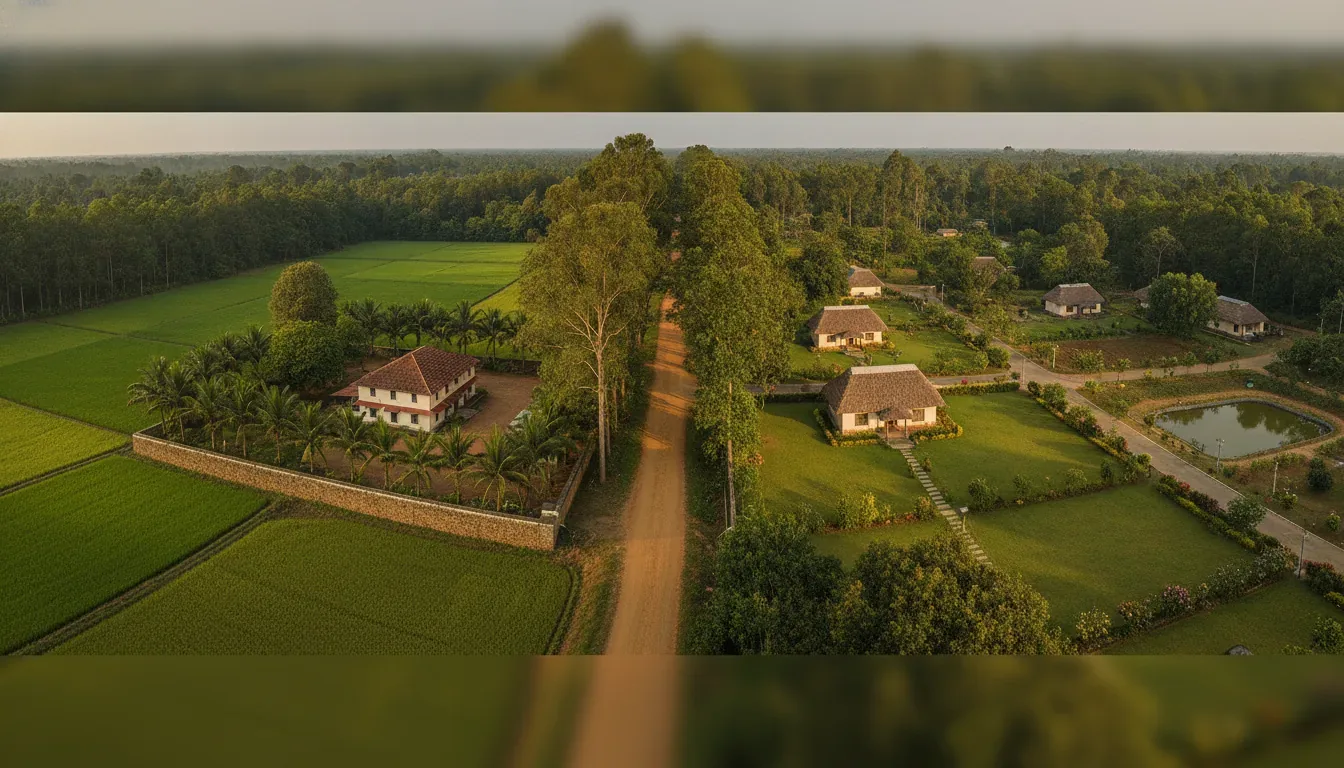
- you would like to arrive at a kept estate, with other owners around
- you accept the operator's rules and an annual charge, and have read the agreement first
The difference shows most clearly when the two sit side by side.
How do a farmhouse and a managed farm plot compare, side by side
This table sets a built farmhouse and a managed farm plot side by side, so you can compare them on eight things: cost, time to first stay, control, upkeep, security, everyday use, selling later, and the rules on building and buying.
| What you are comparing | A built farmhouse | A managed farm plotCost |
|---|---|---|
| Cost | You pay for the land, then the house, then the services a rural site needs (borewell, power connection, septic tank, approach road, compound wall), then every year's upkeep. One Bengaluru builder publishes construction at about Rs 1,800 to Rs 3,000 per sq ft depending on the finish, plus 10 to 20 percent for distance (Ciara Homes, 23 August 2026). | You pay for the plot, and the cottage if you buy one with it, then an annual maintenance charge per square foot of plot area for the common estate. Commercial terms are project-specific and set out in the agreement. |
| Time to first stay | Land checks, then permission or conversion, then plan sanction, then the build, in that order. | Sooner if a cottage is already built. If not, it depends on the operator's build route. |
| Control | You decide the design, what is grown, who visits and whom you hire. | The operator decides the crops and runs the common areas. Your say is what the agreement gives you. |
| Upkeep | You hire, pay and supervise every job. | The operator handles the plantation, common landscaping, internal roads, drainage and routine supervision. Your cottage's repairs, interiors and utilities stay with you. |
| Security | An empty house on its own land. You arrange the wall, a caretaker and any remote monitoring. | One plot among many on a supervised estate. |
| Everyday use | Private, and exactly as well kept as you arranged. | You arrive at a kept estate with other owners around, and you share the setting. |
| Selling later | A thinner market than a city flat. A buyer will check the documents, the access and the condition of the house. | A thinner market than a city flat. Ask whether the plot and its maintenance agreement transfer to a buyer. |
| Rules on building and buying | Usually agricultural land. In Karnataka a farm house built under the farm-house route is limited to 10 percent of the holding, and other residential use can need DC conversion. NRIs cannot buy agricultural land, plantation property or farmhouses in India under FEMA. | Usually agricultural land, with the same 10 percent limit and DC conversion rules. NRIs cannot buy agricultural land, plantation property or farmhouses in India under FEMA, whichever format. |
Neither column gives a return, rental income or appreciation figure, because none can be stated honestly on a general page like this. Each column hides a set of jobs and trade-offs, and they are worth taking one at a time, starting with the farmhouse.
What do you get with a built farmhouse, and what do you take on
A built farmhouse gives you complete control over a house and land that are only yours: the design, what grows, who visits and whom you hire. In return you take on the land checks, the permissions, the build and every year's upkeep, yourself or through people you hire and supervise.
There is no operator, no estate rule and no annual charge to anyone else. The privacy is real too. The gate is yours, and so is the choice of who comes through it.
Here is what you take on.
- Before you pay, you and your own advocate check the RTC, the Encumbrance Certificate, the mutation records, the survey sketch and a PTCL check.
- A permission or DC conversion check comes first, then a sanctioned plan or building licence, usually from the Gram Panchayat.
- Materials and labour have to travel to the site. One Bengaluru builder prices a farmhouse build at 10 to 20 percent above an equivalent city build for this reason (Ciara Homes, 23 August 2026).
- On a city plot, water, power and drainage arrive at the boundary. On rural land you build them yourself: a borewell and pump, a power connection, a septic tank, the approach road and a compound wall.
- Groundwater varies by area. Buyers on the Team-BHP forum report borewells around 500 ft deep on the Bengaluru outskirts, so get the water tested before you plan a garden.
- After the build, the caretaker, the repairs and the garden are yours to arrange and pay for, every year.
A built farmhouse is the better choice for a family that lives close enough to visit often, or has someone it trusts nearby, and wants to run the place its own way. For that family, full control is worth the work. The other column works the other way round: a managed farm plot hands the work over, and asks for something back.
What do you get with a managed farm plot, and what do you give up
A managed farm plot gives you a freehold plot registered in your name, on an estate where the operator plants, maintains and harvests, and sells the produce, so the farming and the common upkeep are not your job. In return you give up control of the farming, pay an annual maintenance charge that can be revised, and depend on the operator doing the work well for years.
Ownership is freehold, with the title registered directly in the buyer's name, and a separate maintenance agreement governs how the estate is run. At Vibez Estates, which publishes this guide, the harvest is marketed through Vibez Agro Tech Solutions, and owners receive periodic plantation updates and an annual yield statement.
What you give up deserves the same plain treatment.
- You give up control. The operator chooses the crops and runs the common areas, estate rules apply, and your rights are what the agreement says they are.
- You pay a recurring charge. The annual maintenance charge is set per square foot of plot area, and it can be revised. Under Vibez's stated terms, any revision has to be supported by actual operating costs and told to owners in advance.
- You depend on the operator. The plot is only as well kept as the operator keeps it in year five and beyond. Owners in this category have complained publicly about heavy maintenance fees with no clear account of what the money paid for, and that complaint is the reason to read the maintenance agreement before you pay, whoever the operator is.
If you are wondering whether an operator will still be around to do the work, look at its record. Vibez Estates has been operating since 2009, seventeen years, with 25+ projects delivered and 1,100 acres under management
A managed farm plot is the better choice for a family that wants land and a cottage in its own name, cannot be there often, and would rather pay an operator it has checked than run the estate itself. The real difference between the two comes down to a list of jobs, and who does each one.
Who does the upkeep in each case, and what does it involve
In a farmhouse you own, the upkeep is yours: you hire, pay and check on everyone who works on it. On a managed farm plot, the operator runs the farming and the common estate under an annual charge, and the repairs, interiors and utilities of your own cottage stay with you.
| The job | In a farmhouse you own | On a managed farm plotPlantation and landscaping |
|---|---|---|
| Plantation and landscaping | You hire and supervise | The operator, within the maintenance charge |
| Internal roads and access | Your approach road is yours to build and maintain | The operator maintains internal roads and common access areas |
| Sewage and drainage | Your septic tank and drains | The operator maintains the estate's sewage and drainage systems |
| Water | Your borewell, pump and sump | |
| Supervision and labour | You find, pay and oversee labour, often a live-in caretaker | The operator provides routine estate supervision and coordinates labour and material for common maintenance |
| Reporting | Nobody reports to you unless you arrange it | Periodic owner updates and issue escalation |
| Repairs to your house or cottage | You | You (cottage-specific repairs are excluded from the charge) |
| Interiors and utilities | You | You (excluded from the charge) |
| Anything extra you ask for | You | You, charged separately (owner-requested services are excluded) |
Who will maintain what, on the managed side, comes from the operator's published scope. The maintenance charge covers plantations and common landscaping; internal roads and common access areas; sewage and drainage systems; common infrastructure; routine estate supervision; labour and material coordination for common maintenance; periodic owner updates and issue escalation. It excludes cottage-specific repairs, interiors, utilities, hospitality-operation expenses and owner-requested services, which are handled separately.
The list is printed here in full for one reason. The common complaint in this category is finding out late what a charge did and did not cover.
What the upkeep costs each year, in either format, is not stated here.Until those are in hand, this page compares who does the work, not what it costs. One job neither list fully covers is keeping the place safe when nobody is there.
Who keeps an eye on the place when nobody is there
A farmhouse used on weekends spends most of the week empty, so it needs a compound wall, a caretaker or someone nearby, and a way to watch water and power from the city. On a managed estate the common areas are under routine supervision; ask what security covers your own cottage.
One Bengaluru builder's advice for a weekend farmhouse is to plan for the building standing empty on weekdays: durable, low-maintenance finishes and good waterproofing, secure doors and windows, a caretaker's room, and a way to monitor water and power remotely (Ciara Homes,). The compound wall and gate usually come first, for security reasons.
On a managed farm plot, the maintenance charge covers routine estate supervision of the common estate. By the published list, it does not include security for an individual cottage. So ask the operator who is on the estate, at what hours, and whether anyone checks your cottage while you are away. Neither format is safe or unsafe by default. Each is as safe as the arrangements you have checked. Once a family owns a plot, the next question is usually whether it can build a house on it later, and what that takes.
Can you build a farmhouse on the plot later, and what permissions does that need
Building a farmhouse on agricultural land in Karnataka is allowed only within limits: the farm-house route caps the building at 10 percent of the holding, and a house used as a villa, a rental or a commercial stay can need DC conversion first. On one acre, 10 percent is 4 guntas, or 4,356 sq ft, so confirm the plot's status with an advocate before you buy to build.
The rule sits in Section 95 of the Karnataka Land Revenue Act. The 2015 amendment (Act 31 of 2015) says a farm building or farm house "shall not be more than ten percent of his holding subject to maximum of such extent of land as may be prescribed".
The arithmetic is simple. One acre is 40 guntas, and one guntha is 1,089 sq ft. Ten percent of an acre is 4 guntas, or 4,356 sq ft. On a 10-guntha holding, it is 1 guntha, or 1,089 sq ft. That is the ceiling the limit sets, not what a given plot can build; setbacks, access and local rules can reduce it.
Published readings of the Act describe a farm house as a house attached to a farm on agricultural land, used by the farmer as a residence or for keeping equipment and cattle, and not let out for commercial activity.
DC conversion comes in when agricultural land is used for a non-agricultural purpose, such as a residential villa, a rental or a commercial stay, and the order comes from the Deputy Commissioner, whose permission is needed to convert the land. Published guidance differs on a plain residential farmhouse. One Bengaluru builder says any residential structure on agricultural land needs DC conversion, while a land-buyer's guide reads a genuine farm house within the 10 percent limit as falling under the farm-house route. Your advocate should settle which applies to your plot. A build usually needs these steps, in this order:
- Land and title checks.
- The land's classification, and any conversion it needs.
- A building licence or sanctioned plan from the Gram Panchayat or the planning authority.
- Construction.
How long this takes is not yet sourced.
On who can buy, since the 2020 amendment removed Sections 79A, 79B and 79C, buyers of agricultural land in Karnataka need not be agriculturists, though land-ceiling, granted-land and PTCL restrictions still apply. A reinstatement was announced in September 2024 and has not been confirmed as passed.
On a managed estate, ask in writing before you plan to build: is the plot DC-converted, does the operator or the owner build the cottage, what plan approval is needed, and how long it takes.
This section reflects the law and published guidance as read on. Land rules change; confirm with your own advocate before you buy to build. With the work, the security and the rules laid out, the two of you can decide together.
How do you choose honestly, together
The honest way to choose turns on four questions about your own family, answered together before either of you looks at a price.
- How often will we realistically go?
- Who will keep the place running between visits, and will we check on them?
- Do we want to decide what is built and grown, or have it run for us?
- Would we rather pay people we manage, or pay an operator whose agreement we have read?
Then put questions to any operator, including the one that published this guide. Ask for these in writing before you pay:
- The maintenance agreement itself, with its scope, exclusions, billing frequency and how the charge can change.
- Who supervises the estate, and who checks your cottage.
- The plot's conversion status and the build route.
- Whether the plot and the agreement transfer to a buyer if you sell.
- Whether you can speak to a current owner.
An operator that will not hand over its maintenance agreement before you pay has given you your answer.
Visit twice if you can, and go together the second time. The partner who will use the place should see it before the decision, and the papers should go to your own advocate. At a Vibez Estates site visit, the brochure, the title flow and the maintenance agreement are shared up front. A few specific questions come up again and again when people compare the two.